
How to prompt AI 101: Brief, refine and judge
Your goal: Create better teaching materials with AI, using your own expertise to guide and improve the results.
Good prompting isn't about clever tricks or writing long instructions. It's about giving AI the right information, improving its answers and knowing when the result is good enough.
We recommend a simple, evidence-informed process:
- Brief: Give AI clear instructions and relevant context.
- Refine: Review the output and improve it through conversation.
- Judge: Use your professional judgement before applying it.
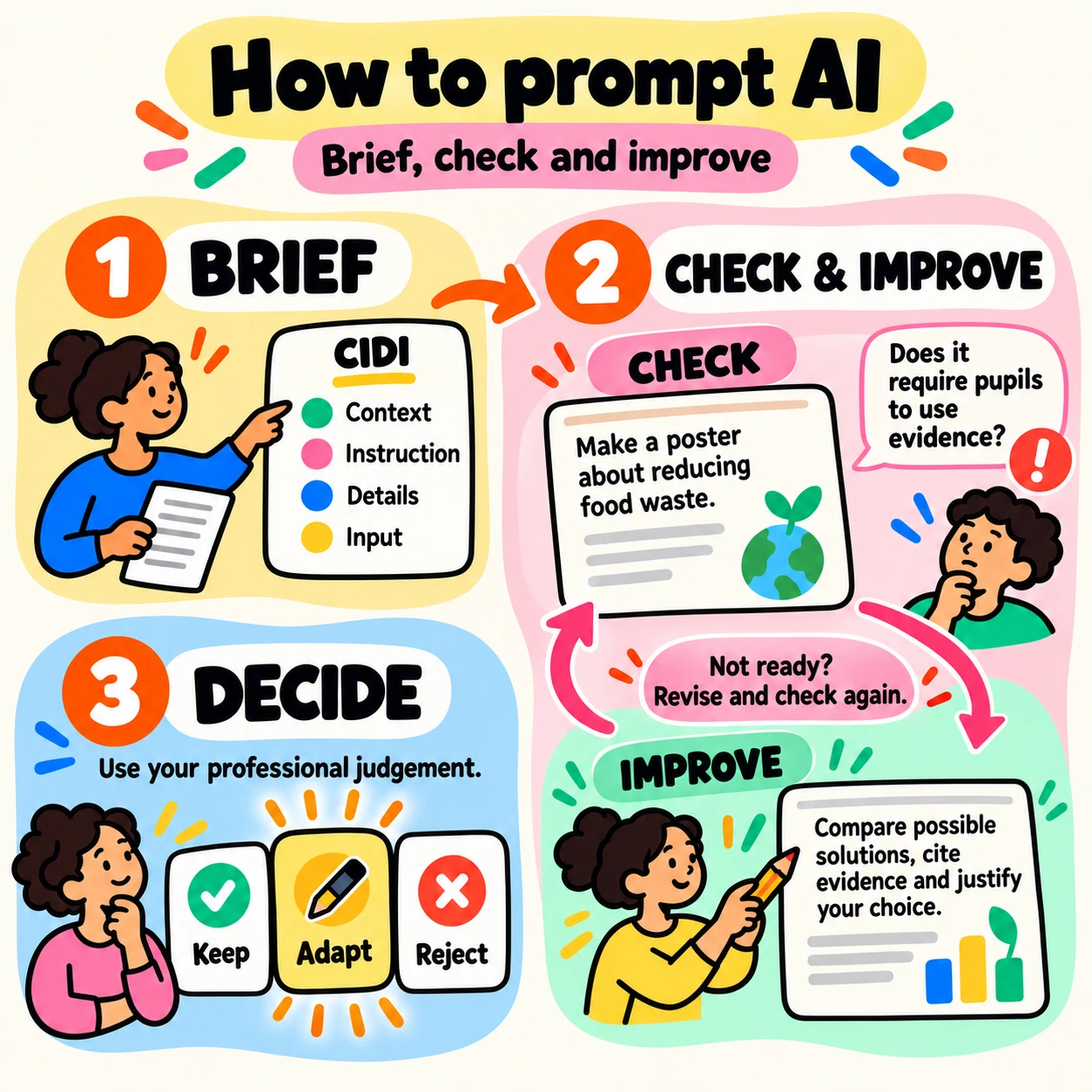
1. Brief: Give clear instructions
Use CIDI, a practical checklist based on OpenAI's prompting principles and AI educator Gianluca Mauro's prompt engineering approach:
- Context: Who are your pupils? What should they learn?
- Instruction: What should AI do or create?
- Details: What requirements, format and boundaries matter?
- Input: What materials, examples or sources should AI use?
Example prompt
My pupils are aged 11–13 and are learning to compare solutions to food waste using evidence.
Create a one-page planning worksheet to help them compare possible solutions before choosing one. Use clear language and include an individual reflection question.
Let pupils make their own decisions. Don't invent school data. Use this project brief: [insert brief].
2. Refine: Improve through conversation
The first answer is a draft, not the final product.
Follow a simple cycle:
Inspect → Identify a weakness → Request a change → Check again
Example follow-up
The worksheet jumps straight to making a poster. Add a step where pupils compare solutions using evidence before deciding. Keep the language simple and the one-page format.
This is conversational refinement: improving the result through focused back-and-forth dialogue instead of starting over.
3. Judge: Is it good enough to use?
Before bringing AI-generated material into your classroom, check:
- Learning: Does it support the intended learning goals?
- Accuracy: Are the facts, calculations and sources correct?
- Suitability: Does it fit your pupils, context and available time?
- Ownership: Are pupils still doing the thinking they need to learn?
Important: AI can invent convincing references. Always check original sources, not just the AI-generated answer.
Your turn
Choose one teaching resource you'd like to improve.
- Brief: Define your learning goal and use CIDI to write your prompt.
- Refine: Generate a draft, identify one weakness and ask for an improvement.
- Judge: Decide what to keep, change or reject, and explain why.
Remember: Brief clearly. Refine deliberately. Judge professionally.
Research & further reading
1. OpenAI. Prompt Engineering Best Practices for ChatGPT. Read the guide
Recommends clear instructions, sufficient context and iterative refinement.
2. Gianluca Mauro. The CIDI Framework for Prompt Engineering. LinkedIn Learning. View the lesson
The reference for our CIDI checklist: Context, Instruction, Details and Input.
3. Improving LLM-Generated Educational Content: A Case Study on Prototyping, Prompt Engineering, and Evaluating a Tool for Generating Programming Problems for Data Science (2026). ACM Technical Symposium on Computer Science Education. Read the study
Finds that detailed instructions and relevant course context can improve AI-generated educational content, measured through correctness, contextual fit and coherence.
4. The Transformative Collaboration of Human Intelligence and Artificial Intelligence in Designing Knowledge-in-Use Science Assessment for Learning (2025). Journal of Science Education and Technology. Read the study
Examines how expert feedback and repeated AI revisions can support the development of educational assessments.
5. Comparing the Quality of Human and ChatGPT Feedback of Students' Writing (2024). Learning and Instruction. Read the study
Highlights the continued importance of human judgement: human-generated feedback outperformed ChatGPT on several quality dimensions in the study.
6. Fabrication and Errors in the Bibliographic Citations Generated by ChatGPT (2023). Read the study
These sources support the underlying practices, not the claim that CIDI or the complete Brief–Refine–Judge process has been scientifically validated as one method.
Your completion ticks stay in this browser.